Light the sign and the front roofline first. Those two decide whether a business registers from a moving car in December, and that is where the choice to stop is made. The entry comes second, the patio third, and the fine detail last. A storefront that gets the first two right reads as open and cared for; one that starts with the detail reads as decorated.
Commercial lighting is a different problem from residential. The audience is moving, and it is deciding something.
What does a business gain from being lit in December?
Visibility at the hour it matters most.
From late November, the sun is down before the working day ends, so every evening customer sees your building in the dark. An unlit facade in a row of lit ones does not read as neutral — it reads as closed. The baseline value of holiday lighting on a commercial property is simply that the building looks open and looked-after during the hours it is busiest.
The second gain is that December is the one month of the year when a business can look festive without it being a marketing decision. Customers expect it, so it lands as warmth rather than as advertising.
What should a restaurant light?
The roofline, the sign, the patio, the entry — roughly in that order.
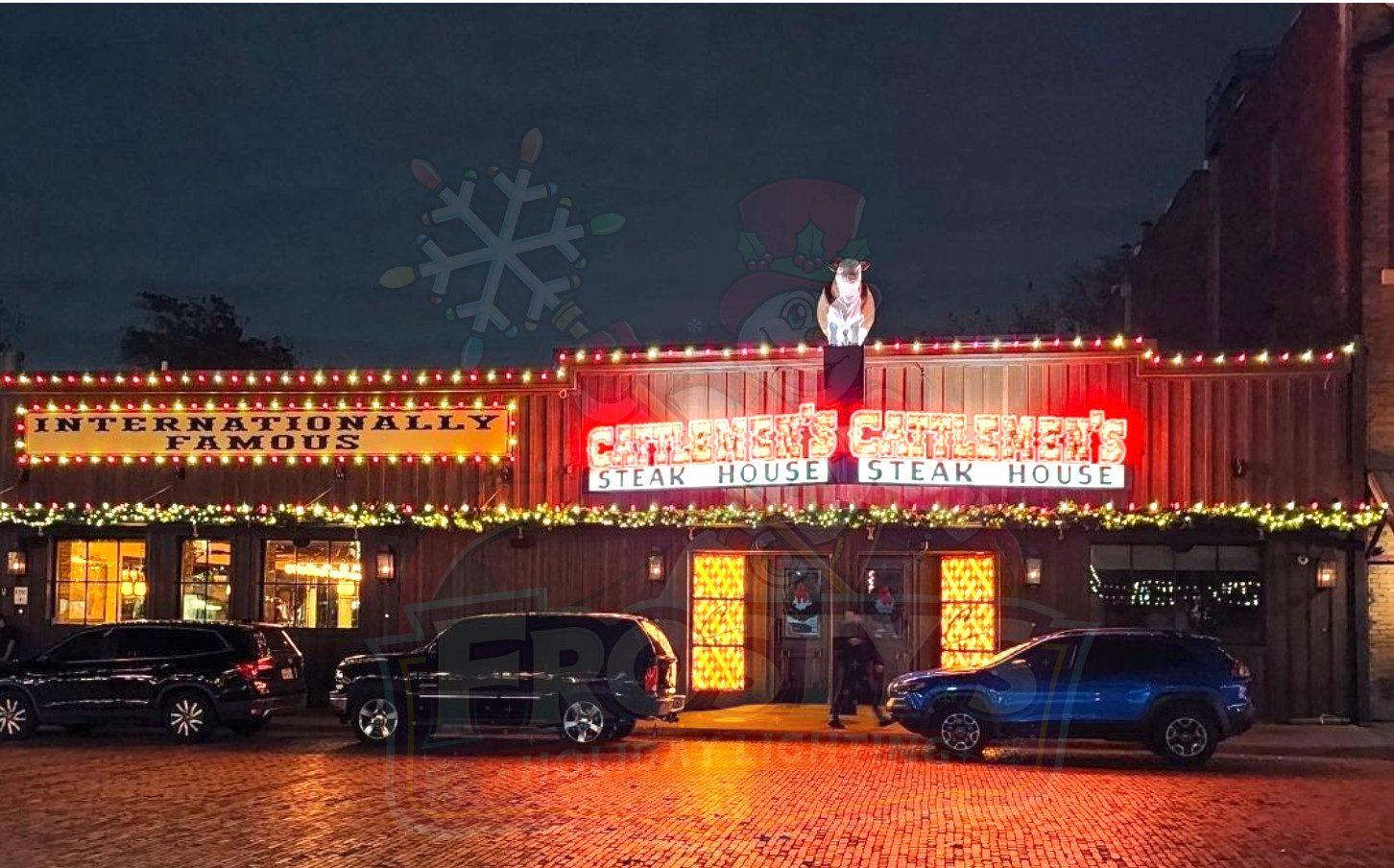
At Cattlemen's Steak House in the Fort Worth Stockyards, the scope was the front roofline, the patio roofline and the outdoor sign. That is a tight list and a deliberate one. The front roofline draws the shape of the building against a dark sky at the distance where somebody is deciding where to eat. The sign makes the decision possible. And the patio roofline does something neither can: it tells people the outdoor space is in use, which on a cold evening is exactly the question a passer-by is asking.
Patios are the most undervalued surface on a restaurant. A patio that is lit looks occupied even when it is half empty; a patio that is dark looks closed even when there are people on it.
Entries come next — the door, the surround, the posts on either side — because once a customer has decided to stop, the entry is what makes the walk from the car feel like part of the experience.
What should a shop light?
The opening, not the facade.
Retail works at walking speed as well as driving speed, and the opening is what carries both. At Javeri Jewelry in Frisco the entry pillars were wrapped in red bulbs, the arch was outlined in red, pre-lit garland with red bows went over the door, and the display windows were lit. Every one of those elements is at or around the entrance. Nothing is spent on the wall between them.
The result is a storefront where the door is unmistakably the subject. The lit arch reads from down the sidewalk and says where it leads, and a color wrapped vertically around a pillar holds its weight at distance in a way a thin outline does not.
Display windows deserve their own mention. They are already the most valuable surface a shop owns, and lighting them as part of the holiday scheme rather than leaving them to the interior lamps makes the whole front read as one composition.
What makes a commercial scheme look considered?
Scale, consistency and commercial-grade material.
Scale: residential-size wreaths and thin garland read as undersized on a commercial elevation, and the difference is visible from a car. Commercial pre-lit wreaths and proper garland are built for the distance they are viewed from.
Consistency: one color scheme across sign, roofline and entry. Mixing warm and cool white on a single storefront is the most common way a commercial job looks improvised, and it is entirely avoidable at the drawing stage.
Material: we install our own commercial-grade LED lights, leased for the season and custom-fit to your building. A run that is fitted to the elevation it sits on is what makes a roofline read as a drawn line rather than a row of gaps.
What does the season look like for a business?
Scheduled, maintained and removed, with nothing on your staff.
The consultation is online: send photographs of the storefront and we design from those plus satellite and street views. For commercial properties an on-site walkthrough is available on request. You approve a drawing of your own building. A 50% deposit reserves your installation date. Tell us your hours and we plan the installation around them as far as we can.
After that, in-season maintenance is part of the service — if a run fails on a Friday night in December, you tell us and the issue is addressed within 48 business hours, without a manager finding a ladder. Removal begins January 2.
Insured with $2 million in general liability coverage, and a certificate of insurance is available on request — most management companies require one on file before a vendor works on a building.
One point of contact runs the account, and the whole team has your file, so whoever you reach in the middle of the season can act on it straight away.
Request a design consultation and we will reply within one business day. The commercial page sets out every element we light on a restaurant, a shop or an institution.
Common questions
Holiday Lighting for Restaurants and Retail: common questions
What should a restaurant or shop light first?
The sign and the front roofline. Those two carry the business from the road, which is where the decision to stop is actually made. The entry comes next, then the patio or any outdoor seating, then anything that only reads once somebody is already on the sidewalk.
Will installation interrupt business hours?
Tell us your hours and we plan the installation around them as far as we can. The design is approved before the date is reserved, so the crew arrives with the lights already custom-fit to your building and works to the schedule we agreed rather than improvising on site.
Can the lighting match our brand colors?
Yes. Matching a brand color is available on request, and several more colors and custom combinations are available on request beyond warm white, cool white, multicolor and the two candy cane schemes. The scheme is drawn onto a photograph of your own storefront in the proposal.
Related
Where to go next.
- Trunk Wraps vs. Canopy Lighting for Trees · Design & Planning
- Why We Light Rooflines With C9 Bulbs · Design & Planning
- Commercial holiday lighting
- All posts in the Holiday Lighting Journal