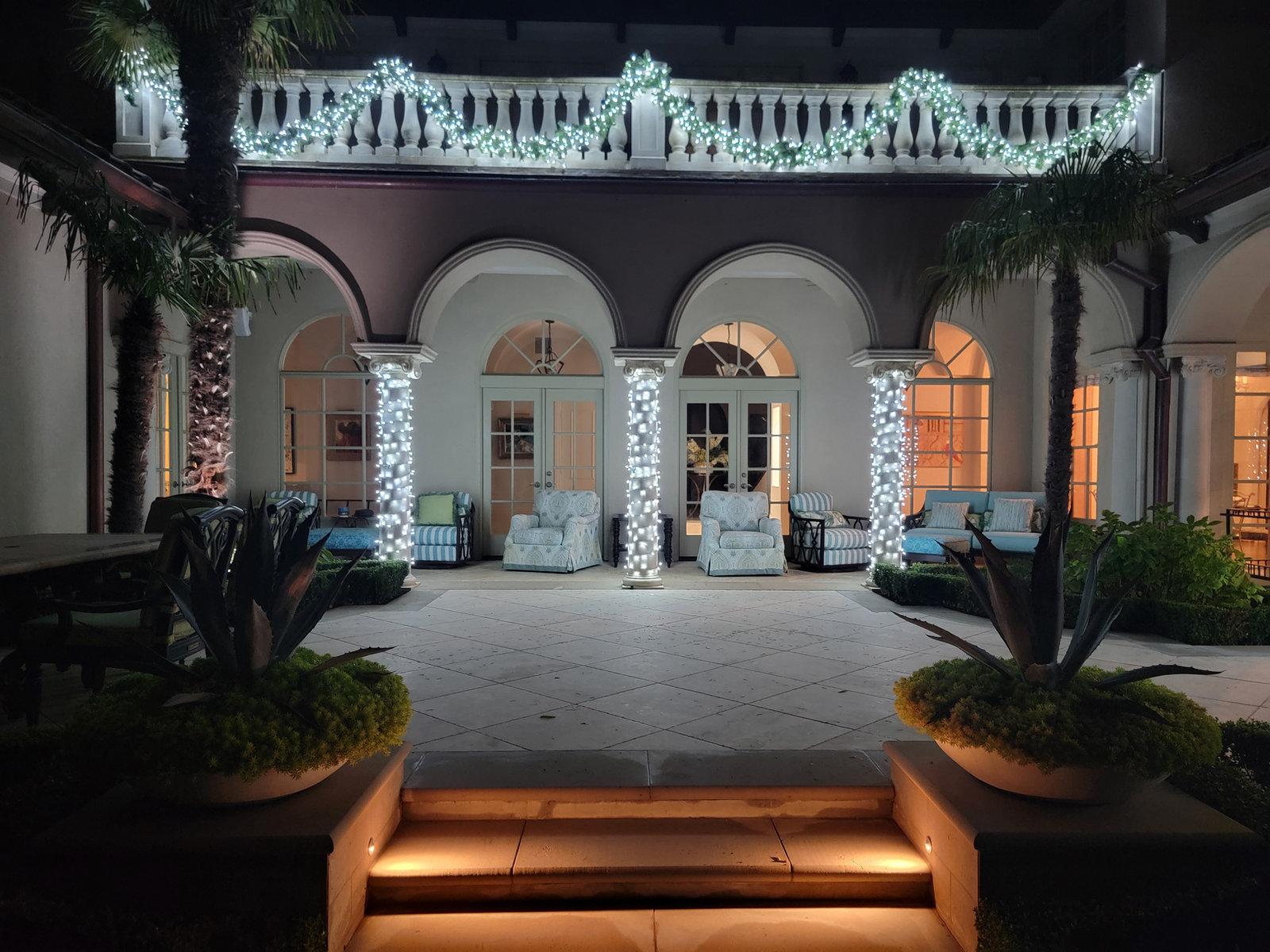
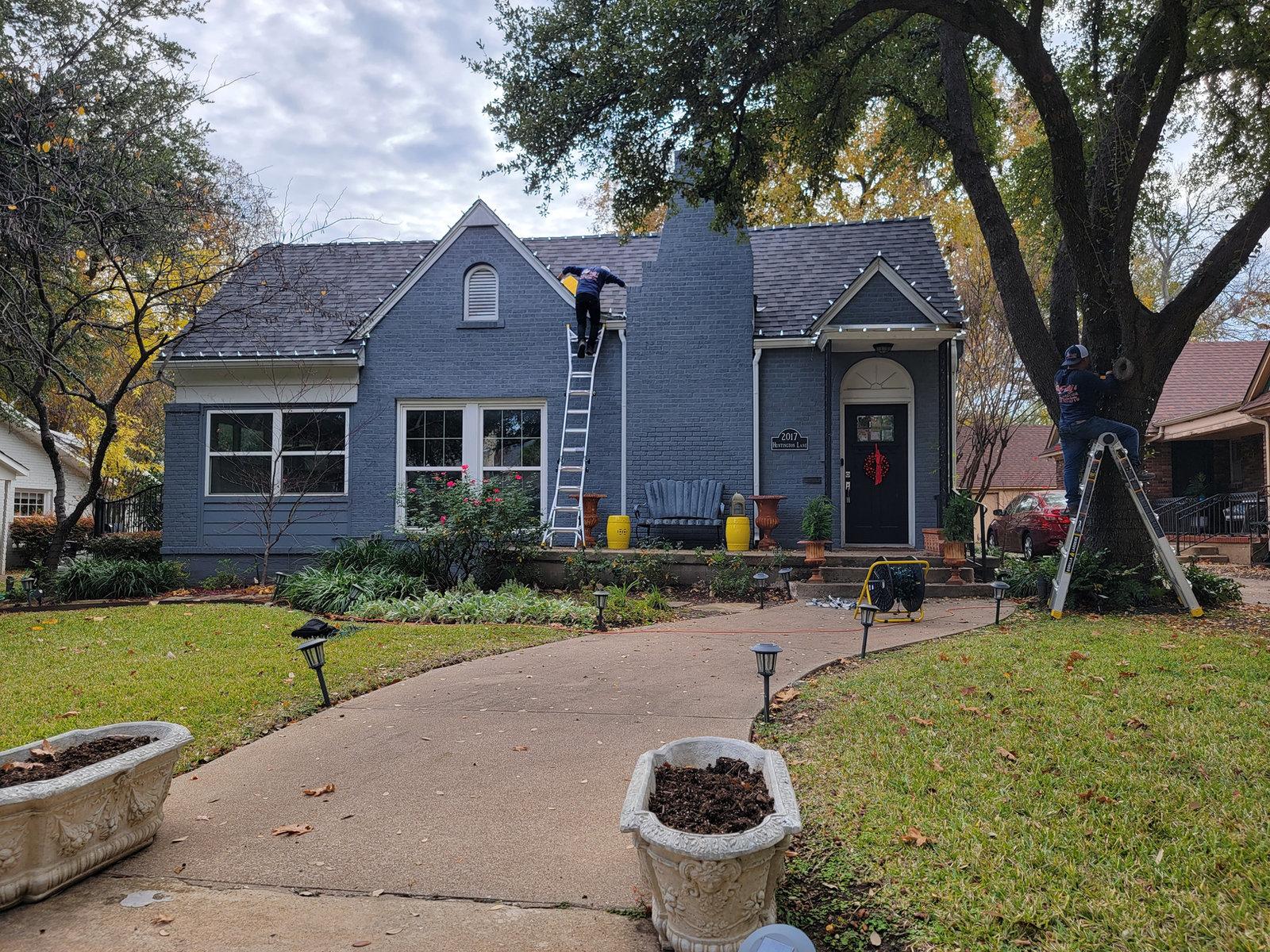
A wrapped tree draws the tree; a lit canopy fills it. Wrapping is done by hand, and the scope is set by your design — trunks only, or trunks and the main branches — so the tree becomes a glowing shape bridging house and street. Canopy lighting puts light up in the branches, so the tree becomes a volume overhead and the space beneath it a room. Canopy is a significantly larger investment.
Some properties want one, some want both, and canopy is rarely the right answer on every tree.
What does a hand-wrapped trunk actually do?
It puts a vertical light source where there is otherwise darkness.
On a deep lot, the lawn between a lit elevation and the road is a void. Nothing in it registers at night, so the house floats and the property reads as smaller than it is. A wrapped trunk fixes that: it is a tall, bright, human-scaled object standing in the middle of the dark, and it pulls the whole composition forward toward the street.
Hand-wrapping is what makes it look like that. Winding by hand, turn after turn, gives an even density of light and lets the spacing open as the wood narrows. It is slow, deliberate work, and it is the reason a hand-wrapped tree looks like a drawn line while a net thrown over the same tree looks like a net.
A line of wrapped trunks does something more again. Along a drive, they turn the approach into part of the design. Across a front lawn, they give the elevation a foreground. At a community entrance, they carry the monument's light outward so the arrival has width.
What does canopy lighting do that a trunk wrap cannot?
It puts light over your head.
Canopy lighting works in the branches, so the tree reads as an illuminated mass rather than an outline, and the ground beneath it changes character completely. A courtyard, a seating area or a stretch of drive under a lit canopy becomes an outdoor room with a ceiling. That is an effect a wrapped trunk cannot produce at any density, because the light is in the wrong place.
It is also the most dramatic thing we do to a tree. On a single specimen — a live oak over a motor court, a tree that frames the front of the house — canopy lighting is often the element guests remember.
The trade is scope. Canopy lighting is a significantly larger investment than a trunk wrap: the work is higher, the access is harder, and a canopy takes far more material to fill than a trunk takes to wrap. That is a design decision to make deliberately, and it is why canopy tends to be chosen for one or two trees rather than for a row.
Which trees suit which treatment?
Structure decides it.
Trees with a strong single trunk and a clear bole — live oaks, red oaks, cedar elms — wrap beautifully, because there is a real vertical to follow before the branches divide. From there the wrap can stop at the trunk or continue into the main branches, which carries the drawn shape of the tree upward without moving into canopy work. How high it goes is a design decision, made with you.
Trees that branch low or have many slender stems are harder to wrap convincingly and often look better with the light in the canopy, where the mass of fine branches is the feature.
Evergreens are their own case. A dense conifer at an entrance takes mini lights through the foliage and reads as a lit cone, which is why multicolor minis on entrance trees against a warm white monument is such a durable combination.
And small ornamental trees near the door — crepe myrtles, Japanese maples — usually want wrapping, because at that scale the trunk and the limb structure are the whole of the tree's shape.
How should you combine them on one property?
Wrap for coverage, canopy for emphasis.
The arrangement that works on most estate properties is a line of hand-wrapped trunks along the drive or across the front, plus canopy on one tree that genuinely earns it — the one that sits over the entry, the motor court or the terrace. The wrapped trunks do the work of filling the dark; the canopy does the work of making one place feel special.
Doing it the other way around, lighting several canopies and no trunks, tends to produce a property with bright patches and dark gaps between them. The eye reads the gaps.
Color should hold across both. Warm white trunks under a cool white canopy reads as two decisions. Pick one temperature for the trees and let the house carry whatever contrast you want.
How do you decide without seeing it first?
By looking at the property the way the street does.
Send photographs from the road, from each side of the approach, and from the end of the drive if the house is set back. We design from those plus satellite and street views, and we draw the tree work onto a photo of your own property so you can see which trunks are doing the bridging and which tree is the one worth a canopy. For larger estate properties an on-site walkthrough is available on request.
Then you are choosing between two pictures of your own front yard rather than between two descriptions.
Request a design consultation and we will draw the tree work with the rest of the design. The residential service page lists every element a proposal can include, hand-wrapped trunks and canopies among them.
Common questions
Trunk Wraps vs. Canopy Lighting for Trees: common questions
What is the difference between a trunk wrap and canopy lighting?
A trunk wrap puts light on the vertical structure of the tree, wrapped by hand. How far it goes is part of the design — trunks only, or trunks and the main branches, to the height your design calls for — so the tree reads as a lit shape rather than a lit outline. Canopy lighting puts light up in the branches themselves, so the tree reads as a lit volume overhead. One draws the shape of the tree, the other fills it.
Is canopy lighting more expensive than wrapping a trunk?
Yes. Canopy lighting is a significantly larger investment than a trunk wrap, because of the height, the access and the amount of material a canopy takes. It is worth it on a specimen tree that is genuinely part of the view, and it is usually not the place to start on a property with several trees.
How many trees should I light?
Enough to bridge the gap between the house and the street, which on a deep lot usually means the trees between the elevation and the road rather than every tree you own. Hand-wrapped trunks along a drive or across a front lawn do more for how the property reads at night than a single lit tree in isolation.
Related
Where to go next.
- Why We Light Rooflines With C9 Bulbs · Design & Planning
- What Makes a Community Entrance Look Premium · HOA & Communities
- All posts in the Holiday Lighting Journal