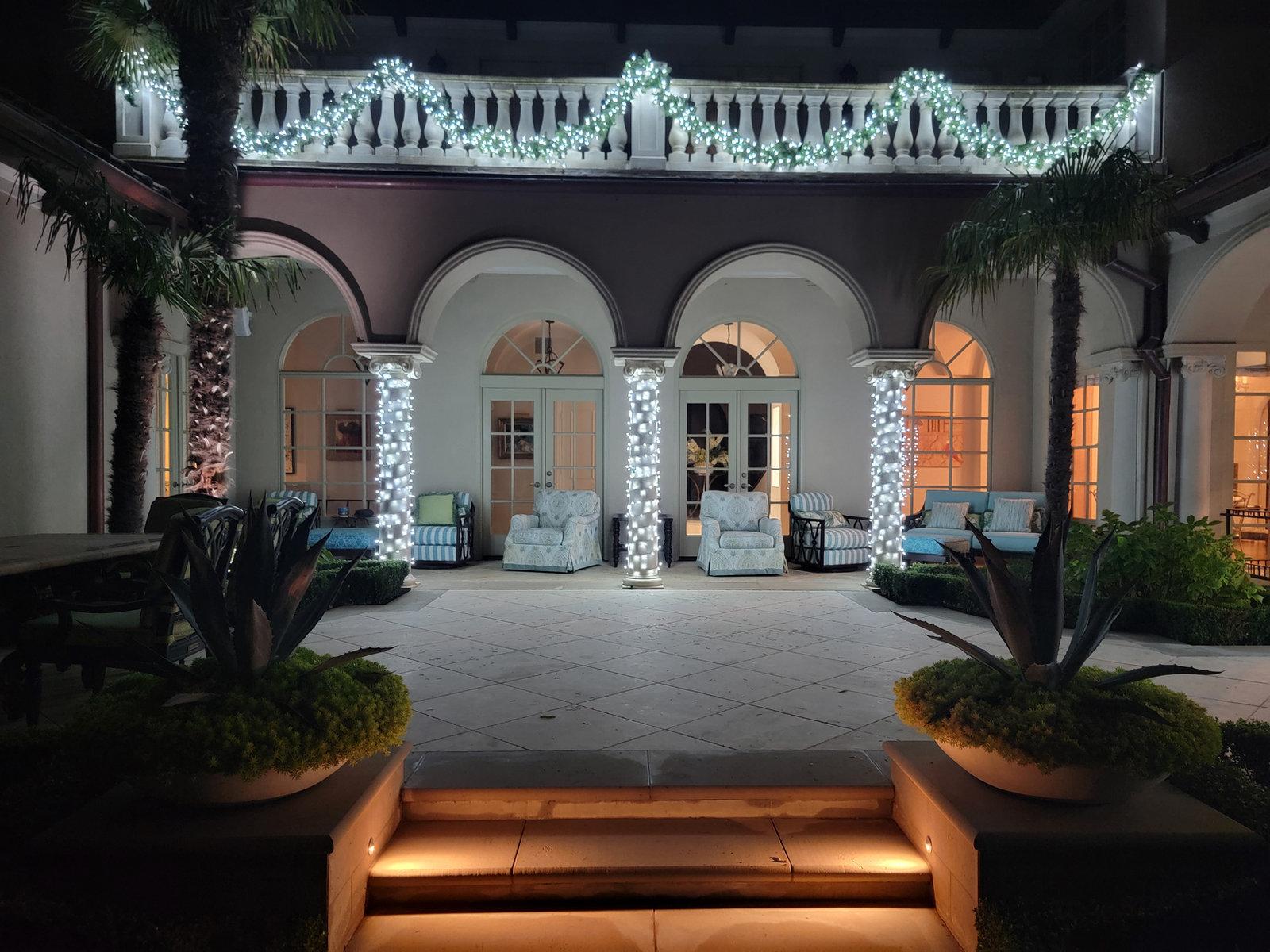
Composition, not quantity. An entrance reads as premium when the monument is clearly the subject, the structures around it are lit to frame rather than compete, and the trees carry the light outward so the whole arrival feels intentional. The elements are ordinary — monuments, signage, guard houses, garland, pre-lit commercial wreaths, wrapped trunks. The arrangement is what separates one entrance from another.
The entrance is the piece of lighting a community sees most, because every resident and every visitor arrives through it.
What is the subject of a community entrance?
The monument and the signage. Everything else frames them.
A community entrance has one job at night: to tell somebody they have arrived somewhere specific. That is the sign and the stone it sits in. Light those properly — a clean run along the top of the wall, light on the sign face itself so the lettering reads at driving speed — and the entrance already works before a single other element goes up.
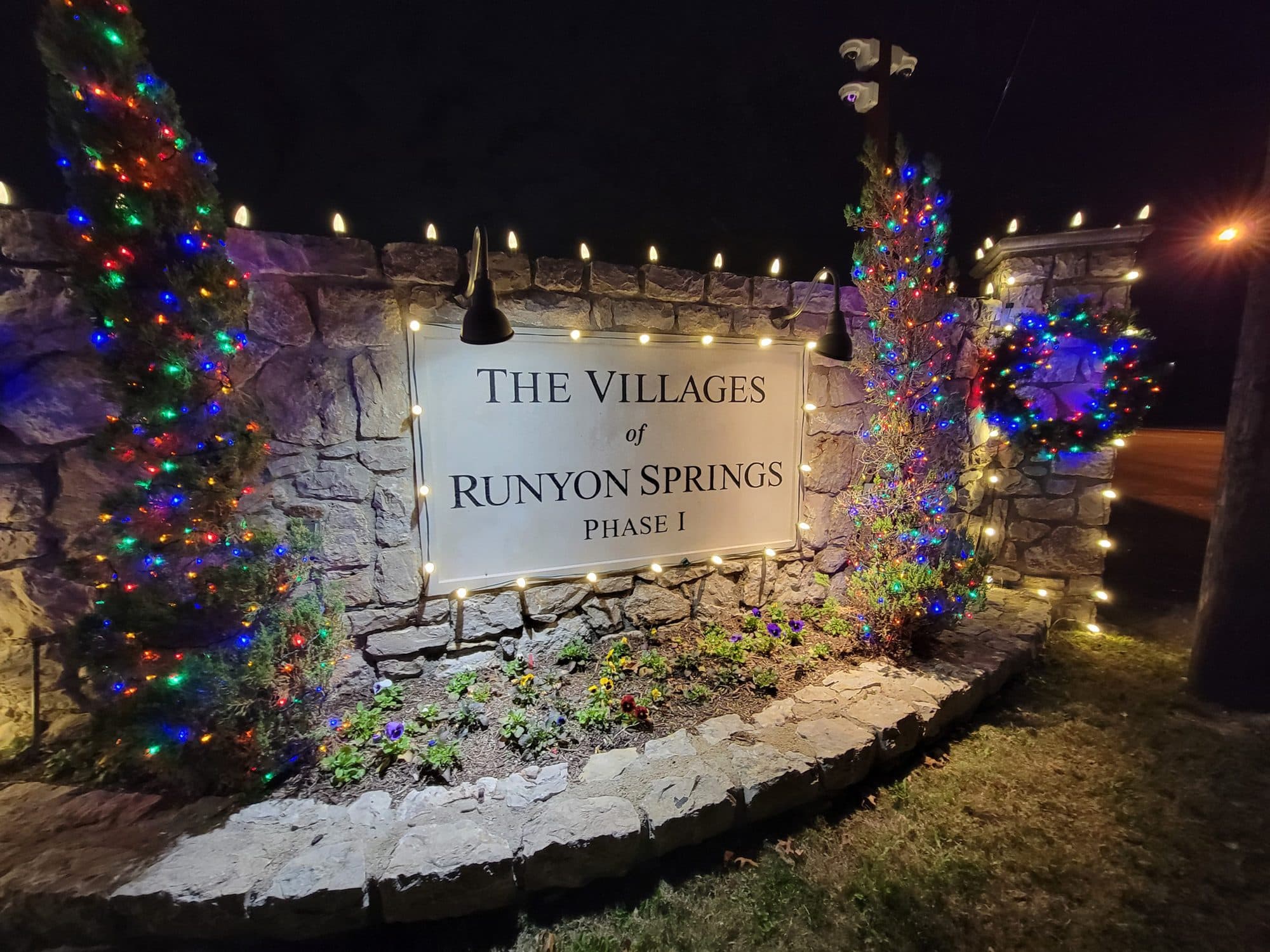
At the Villages of Runyon entrances we lit the monuments in warm white, which is the choice that suits stone. Four large pre-lit wreaths went on the monuments, two per monument, and the trees at both entrances were lit in multicolor mini lights. The contrast is the point — warm white on the architecture, color in the planting — and it is what keeps a monument from looking like a lit box.
Which structures around the entrance should be lit?
The ones a driver can see at the moment of turning in.
Guard houses are the clearest example. A guard house is small, close to the road and directly in the sight line, and outlining it gives an entrance a second lit mass to balance the monument. A community with both entrance security houses outlined reads as deliberate rather than decorated.
Pillars and walls are the other half. A run of lights along the top of a wall extends the monument's line outward and makes the entrance feel wider than its footprint. Columns and pillars wrapped vertically do the opposite — they punctuate — and used sparingly at the gate itself they give the opening a frame.
Paradiso Valle HOA in McKinney is the clearest version of that arrangement we have built: the monument roofline, four pillars, the entrance sign and a pair of wreath sizes, 48-inch and 36-inch, so the wreaths read at the scale of whatever they hang on. Nothing else at the gate is lit, and the entrance is stronger for it.
What not to light is just as important. Fences running far down the street, utility structures and anything behind the gate line pull the eye away from the arrival point and make the whole thing read as scattered.
Where do garland and wreaths belong?
On the monument, at the scale of the monument.
Garland and bows along an entrance sign do something lighting alone cannot: they add physical depth, so the monument has a foreground at night rather than being a flat lit plane. Pre-lit commercial wreaths do the same at a larger scale, and the commercial sizes matter — a residential wreath on a community monument looks apologetic, and the difference is obvious from a car.
At Javeri Jewelry, which is retail rather than a community but the same principle, the scope was red C9 bulbs wrapped around the entry pillars, a red C9 outline on the arch, pre-lit garland with red bows over the door and display window lighting. Every element sits at the opening rather than across the facade, and that is what makes a monument work too.
How do trees finish an entrance?
They carry the light away from the monument so the arrival has width.
Hand-wrapped trees are the signature move here. A line of them along the approach turns the drive itself into part of the entrance, and wrapping by hand is what gives the light an even density and draws the shape of the tree instead of throwing a net over it. How far the wrap goes — trunks only, or trunks and the main branches — is set by the design.
Tree canopies take it further, putting light overhead so the entrance has a ceiling. It is a genuinely different effect, and canopy lighting is a significantly larger investment than a trunk wrap — so it is worth deciding deliberately whether an entrance gains more from more wrapped trees or from fewer lit canopies.
Multicolor mini lights in the entrance trees against warm white architecture is a combination worth asking about, because it reads as festive from the road without making the monument itself look busy.
What does a board need to approve all this?
One document, with the design drawn on photographs of your own entrances.
A board-ready proposal is itemized element by element — monument, signage, guard house, wreaths, garland, trunks — so directors can see exactly what is being voted on, and it covers installation, in-season maintenance with issues addressed within 48 business hours, and removal beginning January 2. Insured with $2 million in general liability coverage, and a certificate of insurance is available on request.
The consultation is online: send photographs of each entrance and we design from those plus satellite and street views. For larger community projects an on-site walkthrough is available on request.
One point of contact runs the season, and the whole team has the community's file, so a director who calls in the middle of December reaches somebody who can act rather than somebody who has to find out.
Request an HOA proposal and we will reply within one business day. The HOA and communities page shows what we light at an entrance and how a board proposal is put together.
Common questions
What Makes a Community Entrance Look Premium: common questions
What should a community light at its entrance?
The monument and signage first, because that is what every resident and visitor actually looks at, then the structures framing it — guard houses, pillars and walls — and then the trees that surround them. Garland and pre-lit commercial wreaths add depth at the monument itself, and hand-wrapped trunks carry the light outward from it.
Should both entrances to a community be lit the same way?
They should read as one composition, which usually means the same colors and the same treatment of the monument, scaled to each entrance. A main entrance and a secondary entrance rarely need identical scope, but a resident who drives through both should not feel they belong to two different communities.
Can a community match its lighting to an existing monument color?
Yes. Matching an existing monument or brand color is available on request, and several more colors and custom combinations are available on request beyond the standard schemes. The scheme is drawn into the board proposal so directors see it before anything is installed.
Related