
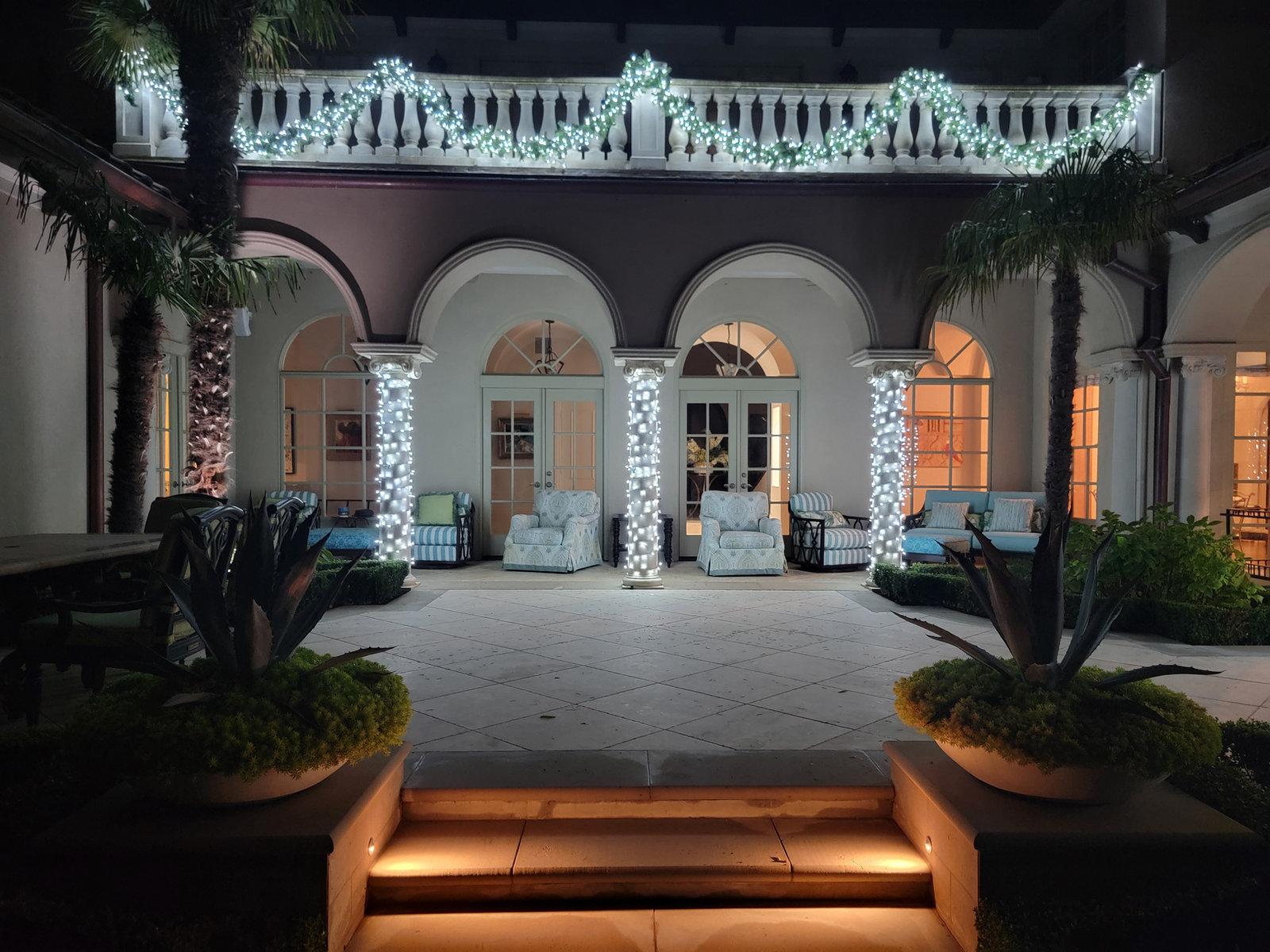
Lead with height. A two-story or estate home is seen from much further down the street than a single-story, so the top roofline is what carries the shape of the house, and everything below it is detail that only works once that line is drawn. Gables next, then columns, windows and arches, then the trees and the drive that bring the eye in from the road.
Most disappointing results on a large house come from treating it as a small house with more square footage. It is not. It is a different viewing distance.
What does a tall house look like from the street?
A silhouette first, detail second.
Stand across the road from a two-story elevation at night and what registers is the outline against the sky — the ridge, the gable peaks, the chimney. Nothing at eye level competes with that at distance. Walk fifty feet closer and the order reverses: the entry, the columns, the planting and the walkway take over, and the roofline becomes a frame.
A design for a tall house has to work at both distances, which is why it is built in layers rather than as one decision. The top layer is read from the road. The middle layer is read from the drive. The bottom layer is read from the walk to the front door.
Which rooflines should actually be lit?
The highest continuous run, and the gables that face the street. Rarely all of them.
The instinct on a large house is to outline every edge, and it is the one instinct worth resisting. Light every roofline and the elevation flattens: there is no hierarchy, nothing recedes, and the house reads as a bright shape rather than a building. Choose the main ridge and the street-facing gables and the house keeps its depth — lit planes advance, unlit ones fall back, and the architecture still does the work.
Steep pitches and ridges that step down toward a wing are where this matters most. A stepped roofline lit in full looks like a staircase. The same roofline lit on its top run looks like a house.
What do you do with columns, windows and arches?
Use them to mark the entry, because at distance the entry is invisible otherwise.
Columns and pillars take light vertically and give the front of a house a rhythm that a roofline cannot. On a portico or a covered arcade, wrapped columns are the single most effective way to tell a visitor where the door is. Candy cane in red and cool white, or red and warm white, is very good here precisely because it is a stripe wrapping a vertical.
Arched entries are the other high-value detail. An arch takes light beautifully — the curve means every bulb sits at a slightly different angle and the whole shape glows rather than reads as dots. On many estate elevations the lit arch is the detail that makes the front read at night.
Windows are a judgment call. Lighting every window on a two-story facade is a lot of light at eye level and it can compete with the roof. Lighting the bay, the stair window or the arched pair above the door gives you the same richness with far less noise.
How do trees and the drive fit in?
They solve the gap between the house and the street.
Estate properties are set back, and a deep front lawn is a dark void between the lit elevation and the person looking at it. Trees fill that void. A hand-wrapped tree is a vertical light source at the right height to bridge house and road, and a line of them along a drive turns the approach itself into part of the design. Tree lighting is fully custom — trunks only, or trunks and the main branches, to the height your design calls for.
Canopy lighting takes it further by putting light overhead rather than only at trunk height, and it changes a property completely — but canopy lighting is a significantly larger investment than a trunk wrap, so it is a decision to make deliberately rather than by default. One effective arrangement is hand-wrapped trees along the drive with canopy on one or two specimen trees near the house.
Pathways and flowerbeds finish the ground layer. They do almost nothing from the road and almost everything from the walk to the door.
How do you keep a big design from looking busy?
One color, and fewer elements lit properly.
A single consistent scheme across roofline, columns and trees is what makes a large elevation read as one composition. Mixing warm white on the house with cool white in the trees reads as two decisions taken by two people. Preston Hollow lots are large, with deep setbacks and long drives, so the lighting has to read from the street rather than from the front door — and a single consistent scheme is what lets it.
And restraint beats coverage. Three elements lit well — the main roofline, the columns, the drive trees — will outperform eight lit thinly, every time.
What should you send us to start?
Photographs from where people actually see the house.
One straight on from the street, one from each side of the approach, and one from the end of the drive if the house is set back. Those four tell us the viewing distances, which is the thing the design has to solve. We work from them plus satellite and street views, so there is no appointment to schedule, and for larger estate properties an on-site walkthrough is available on request.
Request a design consultation and we will draw the layers on a photo of your own elevation. If your house is in Dallas, the Preston Hollow page covers how we work in that neighborhood.
Common questions
How to Light a Two-Story or Estate Home: common questions
How is a two-story home lit differently from a single-story?
By height and by distance. A tall elevation is seen from much further down the street, so the top roofline carries the shape of the house and the ground-level detail disappears unless it is strong. The design usually leads with the highest continuous roofline, then adds gables, columns and arches, then uses trees to fill the space between the house and the road.
Do you have to light every roofline on a large house?
No, and a house usually reads better when you do not. Lighting every available edge flattens the elevation into one bright outline. Choosing the highest continuous run plus the gables that face the street gives the house a shape, and leaves the lower rooflines to do their job as shadow.
Do I need a walkthrough for an estate property?
Not usually. We design online from your photos and satellite and street views, which is enough for most homes. For larger estate properties an on-site walkthrough is available on request, and it is worth taking when the approach is long or the rear elevation is part of the design.
Related