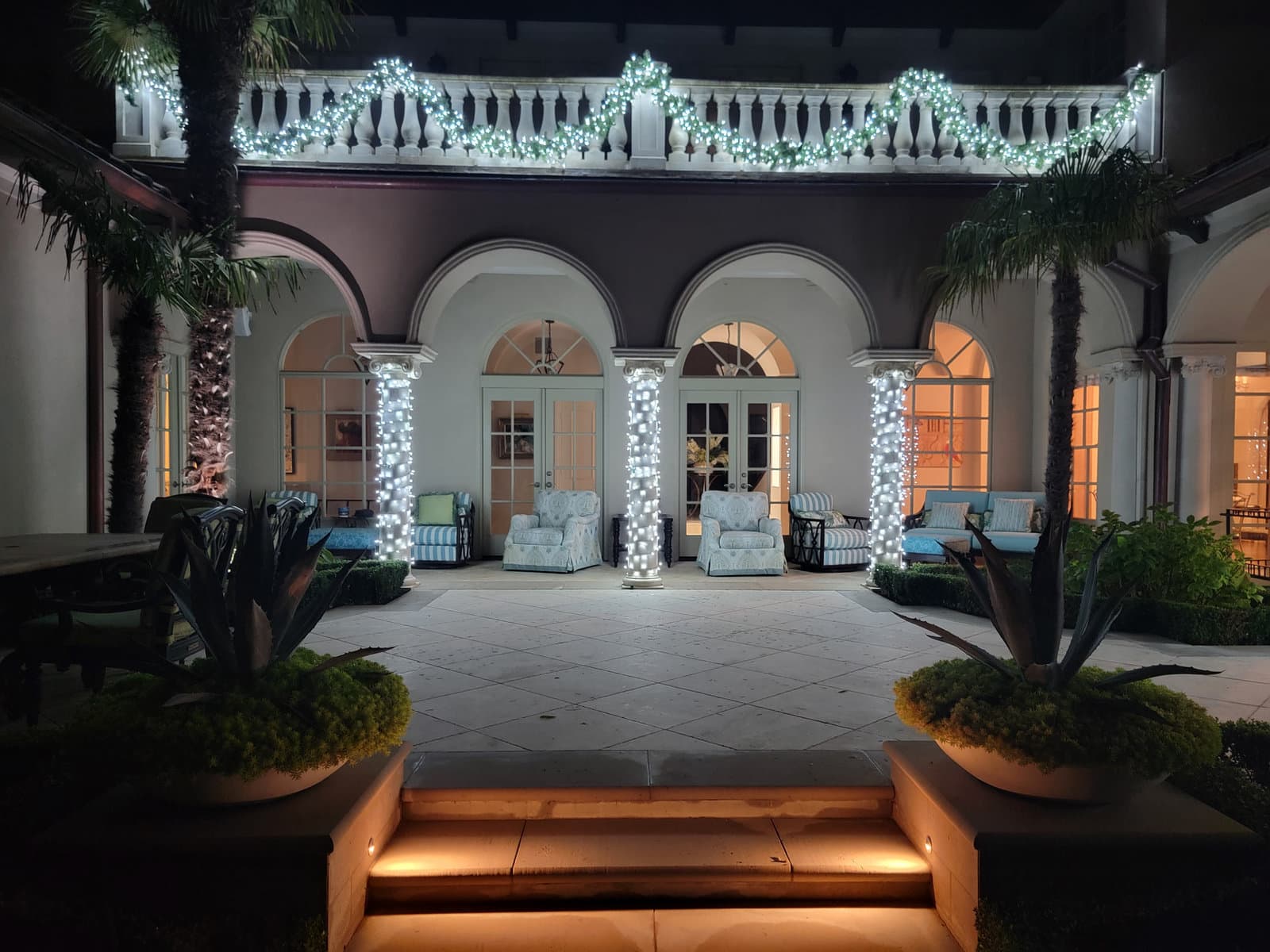
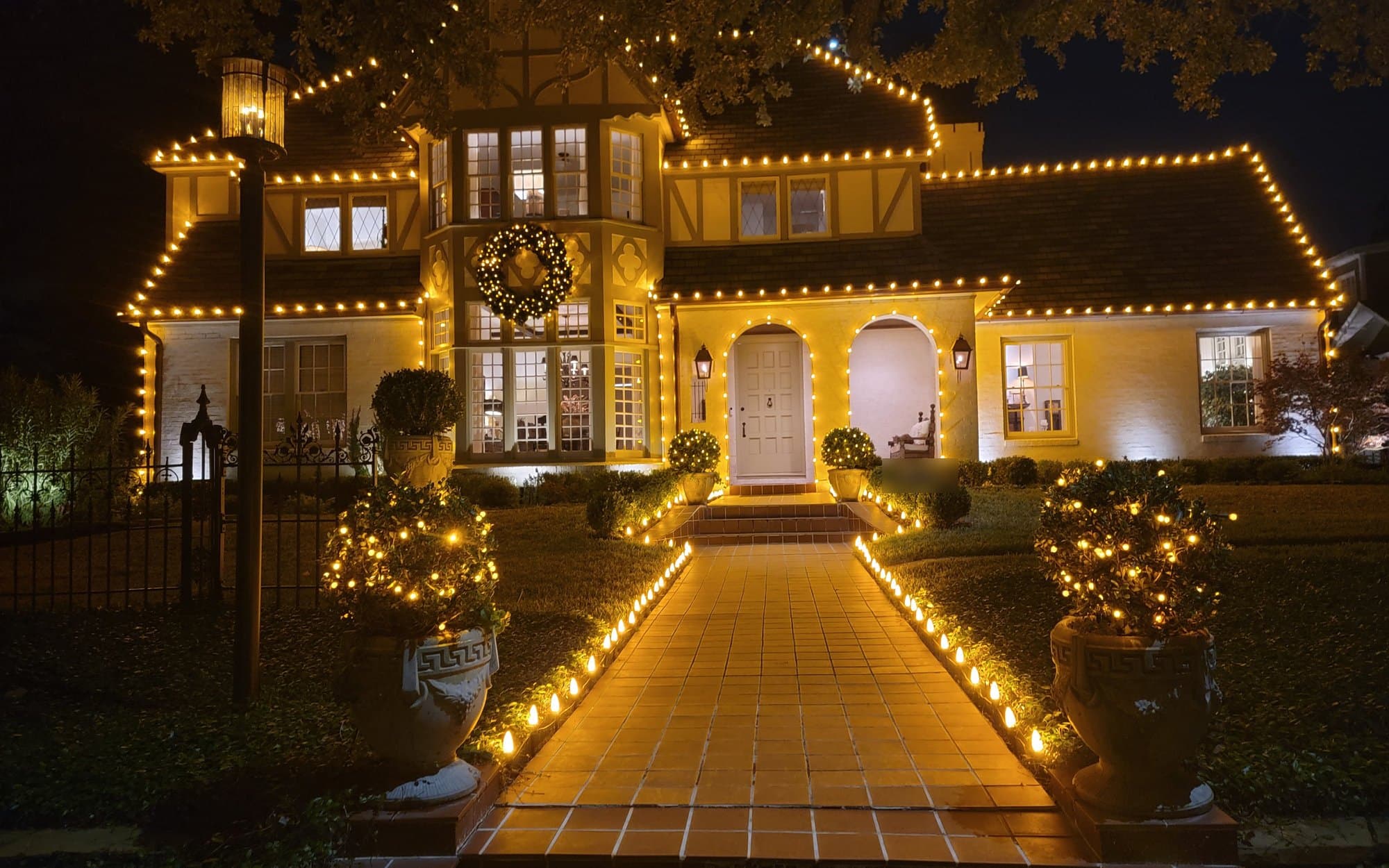
Leasing and buying are not two ways of getting the same thing. Buying means you own a box of lights and inherit everything that comes with it: the storage, the ladder, the testing, the mid-December failures. Leasing means the lights belong to the installer, who also owns the problems. At Frosty's the lights are ours — you never buy them, and we do not install customer-owned lights.
Here is what that difference actually looks like across a season.
What does leasing holiday lights mean?
It means the physical lights are the installer's inventory, not your property. Ours are commercial-grade LEDs, custom-fit to the design we drew for your home, installed in the autumn and taken down beginning January 2. They go back on our shelves, not yours.
Everything around them is part of the same arrangement. The Premium Holiday Light Experience is the design, our lights, the installation, in-season maintenance and the January removal — one service rather than a product plus a labor charge.
Who stores the lights?
We do, and this is the difference people underestimate most.
A roofline's worth of lights is not a small box. Bought lights have to be coiled without tangling, labeled so next year's installer knows which run goes where, kept somewhere dry, and found again eleven months later. In practice they get stuffed into a bin in November, pulled out the following October, and a third of the runs are a knot.
Leased lights skip that entirely. In January they leave with the crew. In October they return custom-fit to your design.
Who gets on the ladder?
Not you, in either direction.
This is where owning lights gets quietly expensive even when the lights themselves were not. Someone has to carry them up, clip them along a roofline, wrap a trunk evenly, and come back down. Then someone has to do it all again in reverse in January, in weather that is worse. If you own the lights and hire labor, you are buying that twice a year. If you own them and do it yourself, you are on a ladder at the edge of a two-story roof in December.
With a lease, installation and removal are both in the same service. Our crew does the design we drew, on the date you reserved, and comes back after the holidays to take it down.
What happens when a bulb or a strand fails?
We replace it, and we do not need your permission to go find a matching one.
This is the practical case for leasing that only shows up mid-season. On a bought set, a dead run in the second week of December means someone hunting for a bulb that matches a product from three years ago, discovering the color temperature has drifted, and living with a patch that is visibly a different white. On a leased set, the failure comes out of our own inventory — the same stock, the same color, the same gauge — and the issue is addressed within 48 business hours.
Working from one inventory is the whole reason we can promise that. It is also why we do not install lights a client already owns: we cannot stand behind the look or the service of a product we did not build the design around.
How are the lights actually attached?
With clips and glue, as appropriate to the surface.
Rooflines and gutters take clips. Some surfaces — certain masonry, trim and sign faces where a clip has nothing to grip — take glue instead. The decision is made surface by surface during the install, and it is part of why the design is drawn on a photo of your property first: by the time the crew arrives, the runs and the fixing method are already worked out.
What does leasing cost you in flexibility?
The honest answer: you cannot put them up yourself in a year you felt like it, and you cannot keep them.
That is the trade. What you give up is ownership of an object that spends eleven months in a box. What you get back is the storage, the two ladder days, the January takedown, the mid-season repairs, and the certainty that this year's lights match last year's because they came off the same reel.
If you want to own a set and handle the season yourself, that is a legitimate choice and we are not the right fit for it. If you would rather the whole season — design, installation, repairs and removal — be one decision made in October, that is what the lease model is for.
What does a season look like from your side?
You send photos and an address. You approve a design drawn on a picture of your own house. A 50% deposit reserves your installation date. The crew arrives on that date. If anything goes out, you tell us and it is handled within 48 business hours. On January 2 we start taking it down, and the lights leave with us.
That is the list. There is no step on it that involves a bin in the garage.
Request a design consultation to start yours, or see how a scheme comes together on a home like yours.
Common questions
Leasing vs. Buying Christmas Lights: common questions
Do I buy the lights or lease them?
You lease them. The commercial-grade LEDs are ours, installed for the season and removed beginning January 2. Design, installation, in-season maintenance and removal are all part of the Premium Holiday Light Experience.
Can you install the lights I already own?
No. We install only our own commercial-grade LEDs. Working from one inventory is what lets us stand behind how a design looks and service it quickly all season.
What happens to the lights in January?
We take them down beginning January 2 and they come back to us. There is nothing to coil, label or store, and nothing of yours occupying a shelf in the garage until next November.
Related