
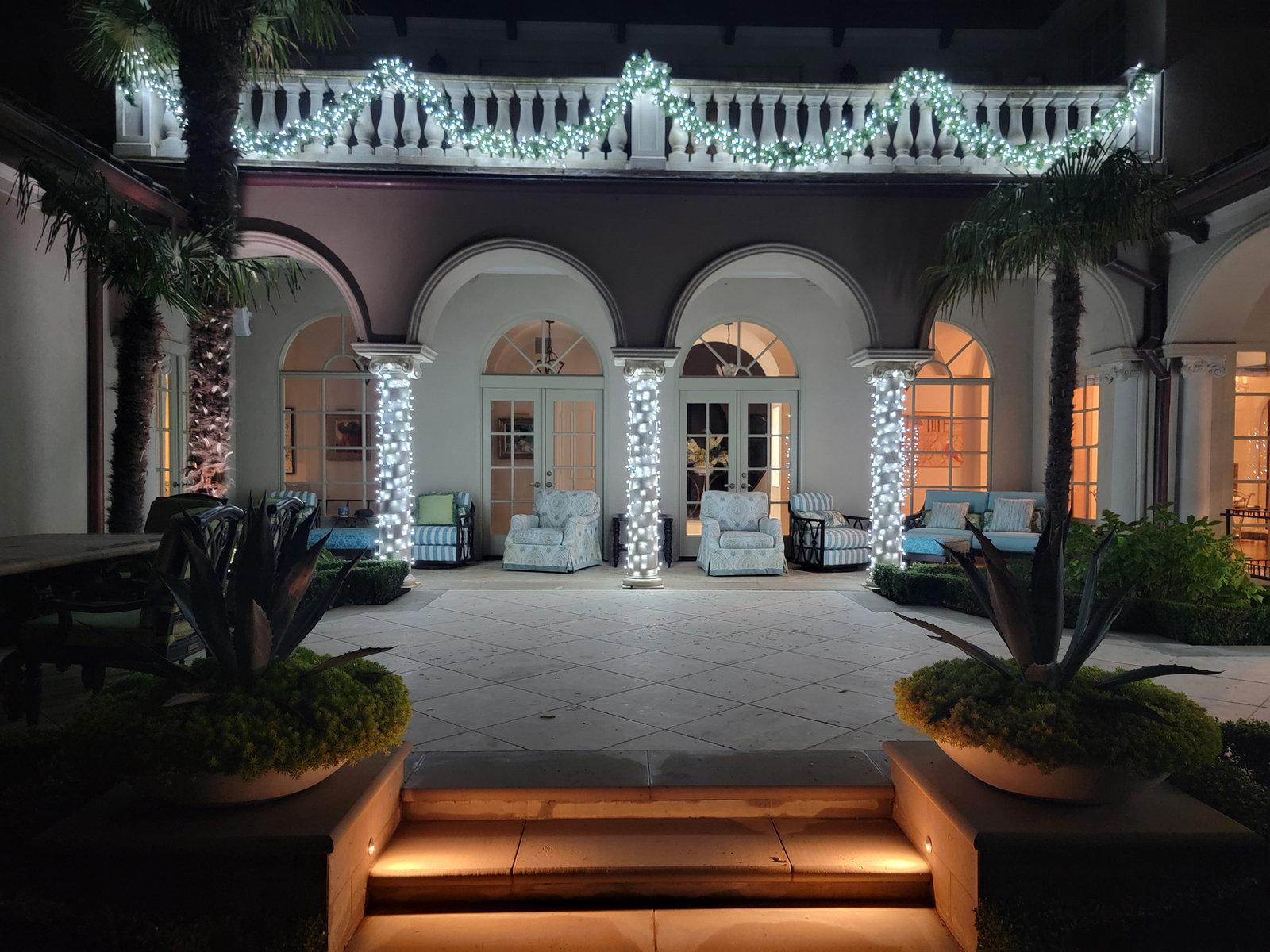
Tell us the date as early as you can. Holiday lighting is scheduled against a season that fills from the earliest bookings forward, so an event date raised at your consultation is easy to build the schedule around, and one raised in late November is working with whatever is left. Tell us about any special event or date ahead of time and we will do everything we can to accommodate it.
What we will not do is promise a date before it is reserved. Here is how to make sure yours is.
Why does the party date change how you book?
Because it removes your flexibility, and flexibility is what the calendar runs on.
A client with no fixed date can take a Tuesday in mid-November or a Thursday in early December, whichever fits. A client hosting on the first Saturday of December needs to be lit before that Saturday, which turns a wide window into a deadline. Deadlines are easy to meet in September and hard to meet in the second week of November, when requests across Dallas-Fort Worth are at their peak and installation dates from late October through early December are filling.
So the event date does not change the work. It changes how early the work has to be booked.
When should you tell us about the event?
At the consultation, in the same message as your address and photos.
The consultation is where your design is drawn and where the schedule starts taking shape, and an event date mentioned there is simply part of the plan. It tells us to schedule backwards from a fixed point instead of forwards from an open one.
Mentioning it later still helps — it is always better than not mentioning it at all — but by then the calendar may have less give in it. The honest version is that early notice is the thing that makes accommodation possible, not the asking.
And if the date moves, tell us that too. A party pushed back a week is easy to absorb; one pulled forward a week usually is not.
What should the timer do on the night?
Start earlier than you think, and run later than the party.
Your lights run on a timer set to the schedule you prefer, and most clients choose about 5 or 6 pm to midnight. For an ordinary December evening that is exactly right. For an event, work from the guest list rather than the invitation: plan for the guests who arrive before the stated time, who in December arrive in the dark.
The end of the night matters more than people expect. Guests leaving a dark house walk to their cars in the dark, and a property that has been lit all evening and goes black at eleven feels like it has been switched off on them. If the party runs late, say so and we will set the schedule to carry past it.
If the hours turn out to be wrong once you are living with them, changing a timer schedule is an in-season request like any other.
What should you light if the party is the point?
The route a guest walks, and the places they stand.
The roofline and the elevation do the work of making the house look lit from the road, and that is what guests see as they arrive. But the experience of an evening happens at ground level: the walkway from the drive to the door, the entry itself, the columns on either side of it, and whatever outdoor space people will spill into.
Pathways and flowerbeds earn their place on a party night more than on any other night of the year, because they are the only elements a guest actually walks through. Wrapped columns and a lit arch tell people where the door is without anyone having to point. And a courtyard, terrace or patio that is part of the plan should be lit as a room rather than as an afterthought, since in a Dallas December people will use it.
What if something fails that week?
You tell us, and it is handled within 48 business hours.
In-season maintenance is part of the Premium Holiday Light Experience. A dead run on the Wednesday before a Saturday party is exactly the scenario the service exists for, and it is not an extra, a favor or a separate call-out. One point of contact runs your season, and the whole team has your file — the design, the scope, the history — so whoever you reach can act on it immediately.
That is worth more than it sounds. The alternative is a homeowner on a ladder in the dark two days before guests arrive.
What is the short version?
Book early, name the date early, set the timer for the guests.
Reserve your installation ahead of the November peak so your date is chosen rather than assigned. Tell us about the event when you first write to us, not once the design is approved. Set the timer to start before your first guest and end after your last. And leave the rest of it alone — the season is covered through to removal beginning January 2.
Request a design consultation and tell us the date in the same message. If you were lit with us last season, rebook and mention the event there instead.
Common questions
Planning Your Lights Around a Holiday Party: common questions
Can you have my lights up before a specific party date?
Tell us about the event or date ahead of time and we will do everything we can to accommodate it. The earlier you tell us, the more room there is to work with — a date raised at the consultation is easy to plan around, while one raised after the calendar has filled may not be. We do not promise a specific installation date before it is reserved.
What hours should the lights be on for an evening event?
Your lights run on a timer set to the schedule you prefer, and most clients choose about 5 or 6 pm to midnight. For an event, think about when the first guest arrives rather than when the party starts, and about whether you want the house still lit as the last cars leave.
What happens if something fails the week of my party?
Tell us and it is addressed within 48 business hours as part of in-season maintenance. One point of contact runs your season and the whole team has your file, so whoever you reach can get it moving immediately rather than take a message.
Related