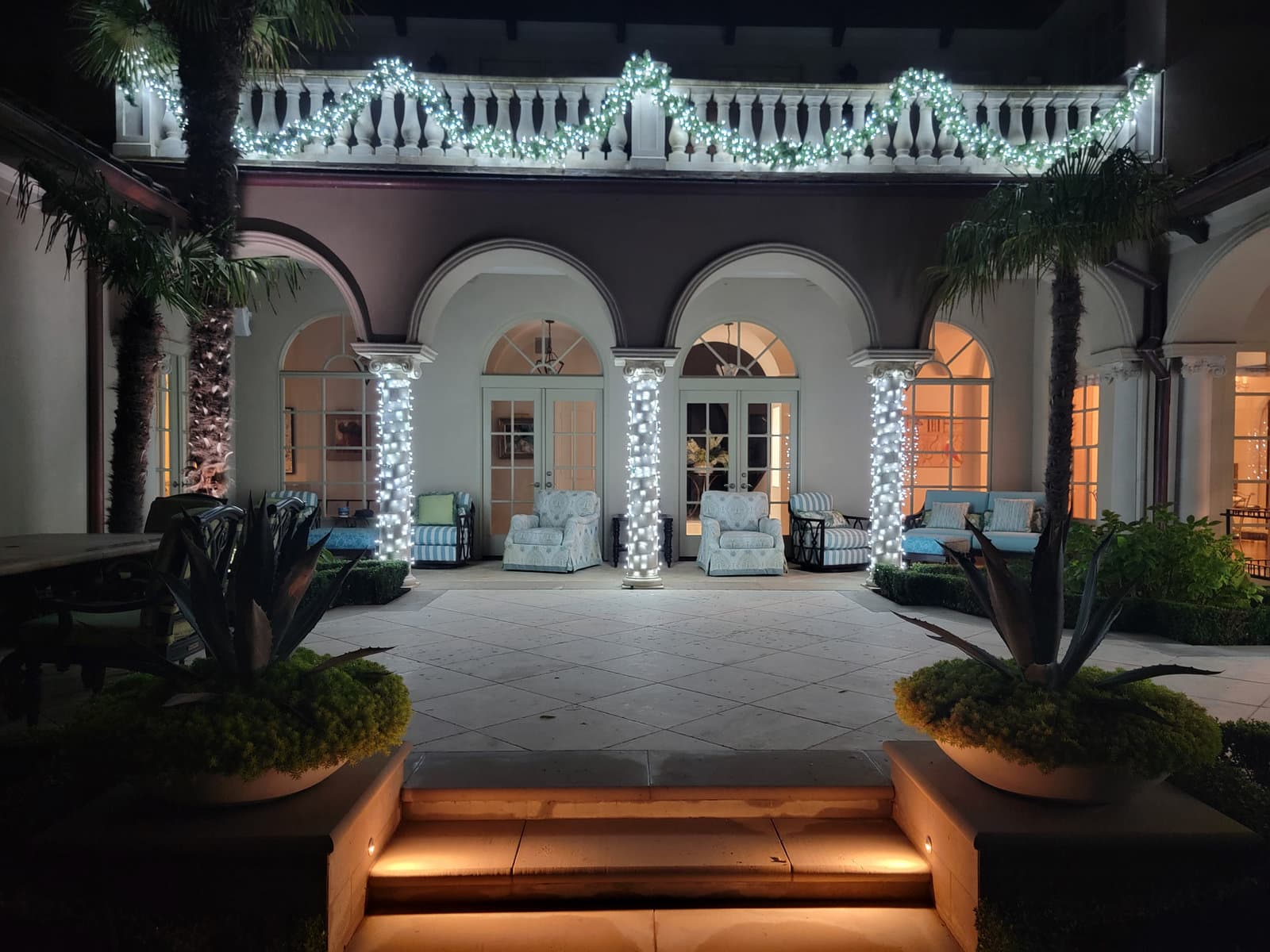
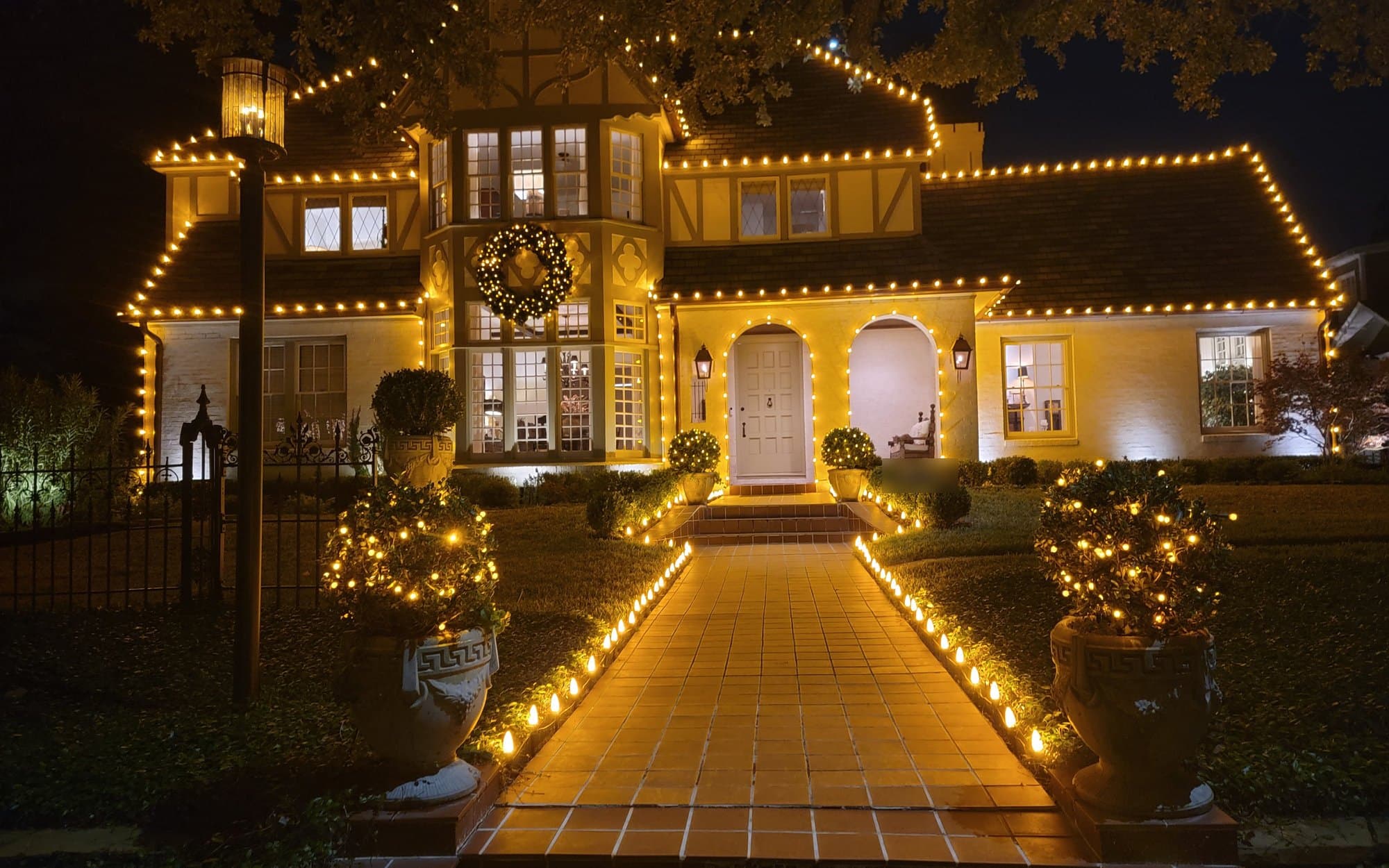
A large home is lit from a drawing before it is lit from a ladder. The design is made on a photograph of your own house, the lights are ours and custom-fit to it, and one proposal covers the whole season — design, installation, in-season maintenance and removal beginning January 2. Scale is the only thing that really changes: more elevation, more trees, more decisions to make on paper first.
Here is how each of those decisions gets made, in the order a homeowner usually meets them.
How is the design for a large home made?
On a photograph of the house itself, before anything is quoted.
Send an address and a few photos and the design is made from those plus satellite and street views. The rooflines, trees and features worth lighting get marked, and the scheme is then drawn onto a photo of your house — so what you approve is a picture of your own elevation rather than a description of one. There is no appointment to keep for this.
On a large property the photographs that matter are the ones taken from where people actually see the house: straight on from the street, from each side of the approach, and from the end of the drive if the house is set back. For larger estate properties an on-site walkthrough is available on request, and it is worth taking when the approach is long or the rear elevation is part of the design.
Whose lights go on the house?
Ours. They are leased for the season and they leave with us.
The lights are our own commercial-grade LED, custom-fit to your home and to the design you approved. Custom-fit is the part that matters on a long elevation: each run is made to the line it sits on, so a roofline reads as one continuous edge rather than as a series of joins. There is nothing for you to buy, store or untangle at the end of the season, and nobody in your household goes up a ladder.
What happens with the trees?
Whatever the design calls for, and that is a decision rather than a default.
Tree lighting is fully custom: hand-wrapped trunks only, or trunks and the main branches, to the height your design calls for. Nothing is wrapped automatically because it is there. On a deep lot the trees are what bridge the gap between a lit elevation and the person looking at it from the road, which is why they are worth deciding deliberately rather than adding at the end.
Canopy lighting puts light overhead rather than only at trunk height, and it changes a property completely — but canopy lighting is a significantly larger investment than a trunk wrap, so it is chosen on purpose, often on one or two specimen trees near the house.
Which colors can a large home be lit in?
Warm white, cool white, multicolor, or candy cane in two forms.
The schemes are warm white, cool white, multicolor, candy cane in red and cool white, and candy cane in red and warm white. Several more colors and custom combinations are available on request. One consistent scheme across roofline, columns and trees is what makes a large elevation read as a single composition rather than as several decisions taken separately.
You can change your color scheme every year at no charge, as long as the design itself — what is lit and where — stays the same.
What happens if something goes out mid-season?
We come back out. That is what in-season maintenance is.
A season of weather, wind and squirrels acts on a large installation more than on a small one, simply because there is more of it. In-season maintenance is part of the same agreement, with issues addressed within 48 business hours, and it is one of the few things in this process that brings somebody to your house in person.
When does it come down, and does anyone need to be home?
Removal begins January 2, and no, nobody does.
Nobody needs to be home for the installation or for the removal, unless the work is inside the home. All we need from you on install day is working exterior outlets on the outside of the home. Tell us about a special event or date ahead of time and we will do everything we can to accommodate it.
Do you work where I live, and are you insured?
We serve all of Dallas–Fort Worth, and travel beyond it for the right project.
Insured with $2 million in general liability coverage, and a certificate of insurance is available on request. Preston Hollow and the Park Cities are two of the places we already work; the Preston Hollow page covers how we work in that neighborhood.
How do you start?
With an address and a few photographs, and nothing else.
Request a design consultation and we will reply within one business day to begin your design. If you want the design thinking behind a tall elevation before you do, how to light a two-story or estate home covers which rooflines to light and which to leave dark, and our residential page lays out the season step by step.
Common questions
Holiday Lighting for a Large Home in Dallas-Fort Worth: common questions
Who installs holiday lighting on large homes in Dallas-Fort Worth?
We do, and it is the work this company was built around. The season is handled end to end from one proposal — design, installation, in-season maintenance and removal beginning January 2 — with one point of contact for you and the whole team on your file, so whoever you reach can act. The design itself is made online, from your address, your photographs and satellite and street views.
Do I need to be home for a large installation?
Nobody needs to be home for the installation or for the removal, unless the work is inside the home. All we need from you on install day is working exterior outlets on the outside of the home. Most of what a large job needs is settled before anyone arrives, in the design you approved.
Do you use my lights or yours?
Ours. The lights are our own commercial-grade LED, leased for the season and custom-fit to your home, so there is nothing to buy, store or untangle and nobody in your household goes up a ladder. We do not install customer-owned lights.
Related